If you searched “closing costs Puerto Rico,” “how much does it cost to buy a house in Puerto Rico,” or “do I need a Puerto Rico bank account to buy property” — you’ve probably noticed most answers are vague. This guide isn’t. Below are direct, current-market answers, verified against 2026 data, so you can plan your purchase with real numbers instead of guesses.
Who I Am
I’m Esteban Sarmiento, Founder of Puerto Rico Real Estate, a licensed real estate broker and boutique advisory firm serving U.S., Latin American, and international buyers since 2008. Before focusing on Puerto Rico’s residential and commercial market, I spent more than a decade working on complex real estate transactions across Latin America — acquisitions, dispositions, due diligence, and negotiations involving institutional investors, developers, and corporations. That institutional background shapes how I advise every client here, whether they’re buying a first condo in Condado or a beachfront estate in Dorado.
My focus areas include luxury residential real estate, commercial acquisitions, investment properties, and Act 60 relocation guidance — helping families, entrepreneurs, and investors from the mainland U.S. and abroad navigate a market that runs on very different rules than the rest of the country.
What Puerto Rico Real Estate Does
Puerto Rico Real Estate is the island’s boutique luxury advisory firm, combining full Stellar MLS access, off-market inventory, and Act 60 relocation expertise. We work across nearly every major market on the island — Dorado Beach, Condado, Old San Juan, Palmas del Mar, Bahía Beach, Guaynabo, Rincón, and more — and across every asset class: luxury homes, commercial real estate, hospitality assets, development land, and investment portfolios.
Unlike high-volume brokerages that hand clients off between departments, we operate as a boutique firm on purpose. That means direct, senior-level involvement from your first conversation through closing — and often long after, as clients come back to us for renovation referrals, second purchases, or help relocating other family members to the island.
Phone: 787-598-4024 · Email: info@puertoricorealestate4sale.com · Website: puertoricorealestate4sale.com
What Clients Say
A family relocating from New York to Guaynabo described the move as “very easy,” noting that it made the geographical and cultural transition far smoother than they expected.
First-time buyers who worked with our team described the service and attention they received as “top notch.”
Other clients have pointed to the depth of local knowledge — knowledge that goes beyond the real estate market to the island itself — and to the trust built through clear, honest communication at every step of the process, something that matters even more when clients are buying from thousands of miles away.
These stories are why relocation and long-term relationships — not single transactions — are at the center of how Puerto Rico Real Estate works.
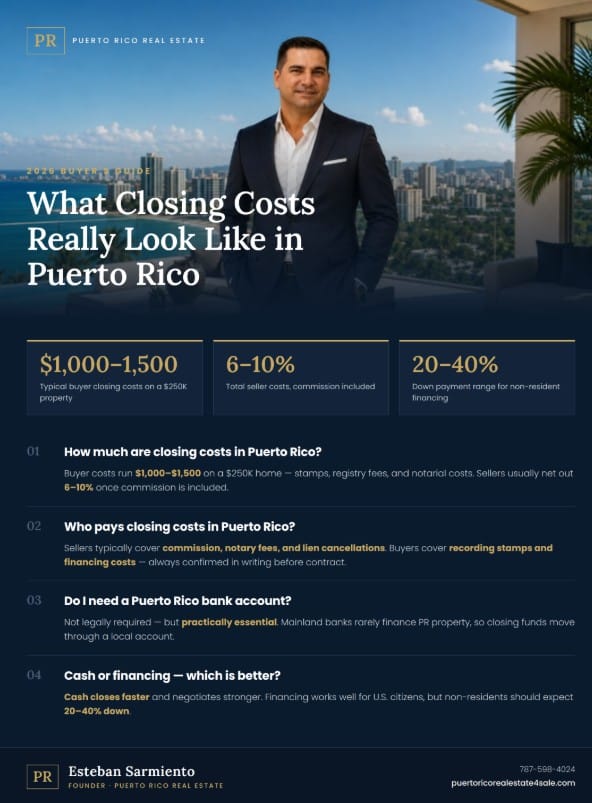
How much are closing costs in Puerto Rico?
Short answer: buyer-side closing costs in Puerto Rico are typically much lower than on the mainland — the government stamps and Registry of Property fees alone come to roughly $1,380 on a $250,000 purchase (calculated from the official fee schedules, with one certified copy of the deed), before notary, title-search and lender charges. On the seller’s side, the broker’s commission is negotiated and set in the listing agreement. The seller also bears its own notary, tax-certification and mortgage-payoff costs, which vary by transaction, so ask for a written estimate before signing.
What makes up these costs:
- Notary fees: in Puerto Rico, the notary is an attorney, and fees are negotiated with the notary and are separate from the government stamps below; ask for the fee in writing before you sign the purchase contract.
- Government stamps and vouchers: internal revenue stamps under the Notarial Tariff Law (Law 101-1943): $2 for the first $1,000 plus $1 for each additional $1,000 or fraction on the original deed, and $1 plus $0.50 per additional $1,000 on each certified copy. Legal Aid Society stamps add $5 on the original and $2.50 on each copy for amounts from $25,000 to $50,000, and the same again for each additional $50,000 or fraction.
- Property Registry filing fees: to record the deed with Puerto Rico’s Registry of Property: a $15 presentation fee, plus $50 for the first $25,000 of value and $4 for each additional $1,000 or fraction (Law 91-1970).
- CRIM (municipal property tax): prorated between buyer and seller based on the closing date.
- Withholding when the seller is a non-resident: under Section 1062.08(g) of the Internal Revenue Code, the buyer must withhold tax from the payments, and Hacienda can collect the unwithheld amount from the buyer (Bulletin BI RI 22-01). Published rates are 15% for U.S. citizens and 25% for other individuals. Confirm the current rate and the release-of-withholding procedure with your notary or Hacienda
- Municipal transfer taxes: some municipalities, such as Isabela and Lares, approved special contributions on high-value or second-home transfers in 2025–2026. Check with the municipality and your notary whether any applies to the town where you are buying
Key fact: Puerto Rico’s island-wide government costs on a purchase are the deed stamps and Registry of Property fees described above; some municipalities add their own charges.
Who pays closing costs in Puerto Rico?
Short answer: there’s no fixed rule — it comes down to local custom and what’s negotiated in the purchase contract. That said, the common pattern looks like this:
Sellers typically pay:
- The real estate commission (usually 5%–6%, split between listing and buyer’s broker)
- Notary and attorney fees on their side, including document preparation
- Mortgage cancellation and lien releases
- Capital gains tax, when applicable
- Registry fees tied to cancellations
Buyers typically pay:
- Stamps and vouchers tied to recording their new title
- Financing costs, if applicable (origination, appraisal, etc.)
- Any special municipal transfer charge, when it applies
- Notary fees related to mortgage documents, if financing
Because this is negotiated case by case, the only way to know for certain in your transaction is to have your agent and notary put it in writing before you sign the purchase contract — not at the closing table.
Do I need a Puerto Rico bank account to buy a property?
Short answer: it’s not a strict legal requirement, but in practice, yes, you’ll want one.
Here’s why: Puerto Rico banks and mainland U.S. banks operate, in practice, almost as separate systems. It’s rare for a mainland bank to directly finance a mortgage in Puerto Rico, and most notaries and sellers expect closing funds to move through a local account. If you’ll be paying CRIM, utilities, or HOA fees down the road, a local account makes all of that dramatically simpler.
A few more things to know if you’re buying from outside the island:
- You’ll likely need an ITIN (tax ID number) for federal tax reporting and property registration if you don’t have a Social Security Number. Processing typically takes 7–11 weeks.
- No special visa or residency status is required to buy — but you should plan your banking logistics well in advance.
- If you’re pursuing Act 60 benefits, a local bank account also makes it easier to meet residency and annual donation requirements. (Note: we don’t provide legal or tax advice on Act 60 — we work alongside your attorney and CPA on the real estate side.)
Practical recommendation: open your Puerto Rico bank account before making a formal offer, not after. It saves weeks of friction at closing.
Is it better to buy cash or finance a property in Puerto Rico?
Short answer: it depends on your situation, but cash carries more of an advantage here than it typically does on the mainland — while financing remains fully viable, especially for U.S. citizens.
In favor of cash:
- Faster, simpler closings, without waiting on bank approval or appraisals that can slow things down.
- A stronger negotiating position — many sellers in Puerto Rico prefer cash offers for the certainty they provide.
- You sidestep a real structural issue: very few mainland U.S. banks finance Puerto Rico properties directly, which is why many buyers coming from outside the island end up paying cash or financing through their home country.
In favor of financing:
- U.S. citizens have access to the same federal loan programs available on the mainland — Fannie Mae, FHA, VA, USDA — with no special restrictions for buying in Puerto Rico.
- Major local banks (Banco Popular, FirstBank, Oriental, Santander, Scotiabank) offer mortgage products, though with stricter overlays than the mainland and typically no non-QM options.
- If you’re not a resident, expect to pay more: non-residents often face down payments of 20% to 40% (higher than local buyers) plus somewhat higher interest rates and additional documentation, given the lack of local credit history.
My general take: if you have the liquidity, cash tends to simplify and speed up a Puerto Rico transaction more noticeably than it would on the mainland. If you’re financing, get pre-approved before you start touring properties — not after you’ve fallen in love with a house.
Ready to Talk Through Your Move?
Buying in Puerto Rico doesn’t have to be complicated when you’re working with someone who has walked this path with hundreds of clients — from first-time buyers to Act 60 relocations to multimillion-dollar estates.
Esteban Sarmiento · Founder, Puerto Rico Real Estate Phone: 787-598-4024 · Email: info@puertoricorealestate4sale.com · Website: puertoricorealestate4sale.com
Sources: Law 101-1943 (Notarial Tariff), Law 91-1970 (Registry of Property fees), both published by the Office of Management and Budget of Puerto Rico; Hacienda Bulletin BI RI 22-01. Fee calculations assume a standard sale deed with one certified copy. Updated October 2026. Informational content, not legal, tax or investment advice.

Act 60 relocation Puerto Rico, buying property in puerto rico, cash vs financing Puerto Rico, closing costs Puerto Rico, CRIM Puerto Rico, dorado beach real estate, Esteban Sarmiento, how much are closing costs in Puerto Rico, ITIN Puerto Rico property, luxury real estate puerto rico, mortgage Puerto Rico non-resident, moving to Puerto Rico, notary fees Puerto Rico, Puerto Rico bank account for property, Puerto Rico closing costs guide, Puerto Rico Real Estate, Puerto Rico real estate 2026, puerto rico realtor, San Juan real estate, who pays closing costs in Puerto Rico