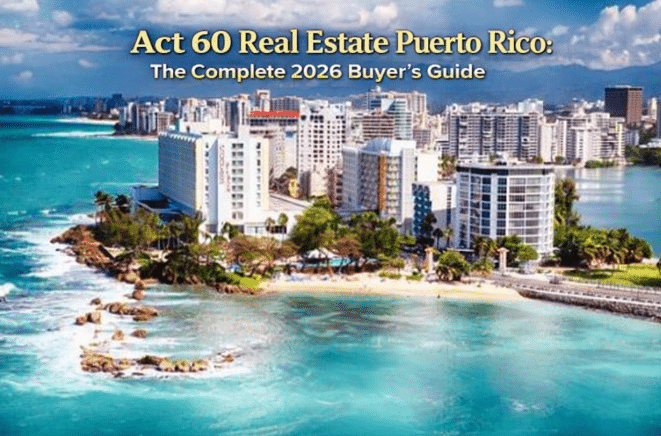
Act 60 Real Estate Puerto Rico has fundamentally changed the conversation about real estate investment on the island. Since its consolidation of earlier incentive codes in 2019, the law has attracted thousands of high-net-worth individuals from the continental United States — and the real estate market has responded accordingly. Median prices in key markets like Dorado, Condado, and Palmas del Mar have appreciated between 38% and 65% since 2020, driven in large part by Act 60 relocatees seeking qualifying residences. For general island information, see Discover Puerto Rico.

This guide covers everything a serious buyer needs to know in 2026: what the law actually requires, which properties qualify, the timeline from offer to compliance, and the market dynamics that affect where and how you buy.
Act 60 is not a loophole — it is a legally structured incentive designed to attract capital and talent to Puerto Rico. Understanding its requirements in detail is the foundation of any sound investment decision.
Act 60 Real Estate Puerto Rico: What Is Act 60 and Why Does It Matter for Real Estate?
Act 60 of 2019, formally known as the Puerto Rico Incentives Code, consolidated several prior incentive acts — most notably Act 20 (export services) and Act 22 (individual investors) — into a single framework. For individual investors, the relevant chapter is Chapter 2, formerly Act 22.
The core benefit for qualifying individuals depends on when the application is filed. For individual resident investors who file by December 31, 2026, the Puerto Rico Department of Economic Development and Commerce (DDEC) applies a 0% rate on net capital gains, interest and dividends. Applications filed after that date fall under Act 38-2026, with a 4% rate. Qualifying export services income has a 4% fixed rate. Actual savings depend on each person’s situation, so consult a qualified tax professional. This is general information, not legal or tax advice.
The real estate dimension is direct and non-negotiable. To qualify and maintain your decree, you must establish genuine residency in Puerto Rico — and purchasing a home is the clearest signal of that commitment.
Act 60 Real Estate Puerto Rico: The 2023 Regulatory Update: What Changed
Regulations tightened significantly in 2023 in response to scrutiny from the U.S. Treasury. Key changes include:
- Annual donation of $10,000 to Puerto Rico-based nonprofits (increased from $5,000)
- 30-day continuous presence requirement in addition to the 183-day threshold
- Enhanced documentation requirements proving bona fide residency
- Stricter IRS auditing protocols for Act 60 decree holders
These changes have made the residency component — including your property — far more scrutinized. Your home is not just a lifestyle choice; it is documentary evidence of your compliance.
Which Properties Qualify Under Act 60?
There is no official Act 60 approved property list. The law does not restrict you to specific developments or price points. What matters is that the property can credibly serve as your primary residence in Puerto Rico.
Act 60 Real Estate Puerto Rico: Primary Residence Requirements
Your qualifying property must be your principal residence in Puerto Rico — not a vacation home, not a rental unit where you occasionally stay. The IRS and Puerto Rico Treasury apply a facts-and-circumstances test that looks at:
- Where you spend the majority of your nights (183-day minimum in Puerto Rico)
- Where your personal belongings, vehicles, and family are located
- Where your doctors, dentists, and service providers are based
- Whether your home is furnished and maintained as a full-time residence
- The physical size and amenity level of the home relative to your lifestyle
Property Types That Work Well
Single-family homes in gated communities offer the clearest documentation trail — HOA records, utility accounts, service provider relationships — all of which support residency claims. Luxury condominiums in buildings with year-round staffing and verifiable access logs are similarly advantageous. Beachfront and oceanview properties in markets like Dorado Beach, Bahia Beach, and Palmas del Mar have become the de facto Act 60 residential corridor for this reason.
The question is never simply “Can I buy this property?” The question is “Can this property serve as documented, credible, primary-residence evidence for my Act 60 decree?” Those are different questions with different answers.
📋 Working with the right broker here matters: Puerto Rico Real Estate specializes exclusively in Act 60 corridor properties. Our team maintains active inventory in Dorado Beach, Condado, Palmas del Mar, Bahia Beach, and Old San Juan — including off-market properties that never appear on public platforms. We work directly alongside your tax counsel to ensure every property we show you is properly aligned with your decree compliance strategy. Call us at 787-598-4024.
Act 60 Real Estate Puerto Rico: The Puerto Rico Real Estate Market in 2026: What Act 60 Buyers Are Seeing
The Act 60 buyer demographic has fundamentally reshaped certain market segments in Puerto Rico. Understanding these dynamics is essential for making a well-timed, well-priced acquisition.
Act 60 Real Estate Puerto Rico: Dorado Beach: The Premier Act 60 Corridor
The Dorado Beach resort corridor — anchored by the Ritz-Carlton Reserve and extending through the East and West Beach communities — has become the most sought-after address for Act 60 relocatees. Residences here range from $1.5 million for smaller units to over $20 million for beachfront estate homes. Inventory is extremely constrained; properties often trade in off-market transactions before reaching any listing platform.
Condado and Ocean Park: Urban Luxury
For buyers who prioritize walkability, dining, and proximity to the financial district, Condado remains Puerto Rico’s premier urban luxury market. Oceanfront condominiums in full-service buildings — Bristol, Bahia Plaza, Cosmopolitan — provide excellent residency documentation while offering a cosmopolitan lifestyle. Prices have stabilized somewhat after rapid appreciation in 2021–2023, presenting a more rational entry point in 2026.
Palmas del Mar: Integrated Resort Living
Palmas del Mar in Humacao offers an integrated resort community with equestrian facilities, two marinas, multiple golf courses, and a full commercial center. For families with children or buyers seeking a self-contained community environment, Palmas presents a compelling combination of lifestyle amenity and Act 60 documentation strength.
Act 60 Real Estate Puerto Rico: Market Data: Q1 2026 Snapshot
- Median luxury home price (above $1M): $2.4M — up 8% year-over-year
- Average days on market for Act 60 corridor properties: 47 days
- Percentage of transactions above asking price: 34%
- Off-market transactions as share of total luxury volume: approximately 40%
The Act 60 Property Purchase Process: A Step-by-Step Timeline
- Months 1–2: Engage Act 60 tax counsel and establish your filing timeline. Begin market education with a broker experienced in Act 60 transactions.
- Months 2–4: Active property search. Given limited inventory in top markets, allow time for off-market sourcing. Identify 3–5 candidate properties.
- Month 4–5: Submit offer, negotiate, and execute purchase contract. Due diligence period typically runs 30–45 days in Puerto Rico.
- Month 5–6: Close. Puerto Rico closings involve a notary-public transaction structure different from most U.S. states. Budget 8–10% in closing costs.
- Month 6–8: Establish residency documentation. Register vehicle, open local accounts, transfer medical providers, document presence.
- Month 8–12: File Act 60 application with DDEC. Processing typically takes 3–6 months.
Filing your Act 60 application is not the same as being covered by it. Your decree takes effect upon government approval, not upon filing. Work backward from your desired effective date to set your property purchase timeline accordingly.
What Working With the Right Broker Changes
In most real estate markets, the choice of broker affects price and convenience. In the Act 60 market, it affects compliance. A broker who does not understand the residency documentation requirements of a decree — who cannot distinguish between a property that photographs beautifully and a property that holds up under IRS scrutiny — is a material liability, not just a service limitation.
The most consequential transactions in this market happen before a property ever reaches a listing portal. Dorado Beach, Bahia Beach, and the most coveted Condado buildings all have properties that trade through broker relationships built over years. Buyers who lack access to that network pay more for less, and often discover the limitation only in retrospect.
📋 How we help: Puerto Rico Real Estate has cultivated off-market access to the island’s most exclusive communities — including properties in the Ritz-Carlton Dorado Beach and Four Seasons Resort and Residences Puerto Rico (formerly St. Regis Bahia Beach) corridors that never appear on Zillow or Realtor.com. Our team provides full Act 60 aligned buyer representation: property search, legal and financial professional referrals, relocation coordination, and post-closing support. For Act 60 buyers, representation is typically provided at no cost to the buyer — commissions are seller-paid at closing.
Act 60 Real Estate Puerto Rico: Common Mistakes Act 60 Buyers Make in Real Estate
Buying Too Quickly Without Market Knowledge
The urgency created by limited inventory and competitive bidding can push buyers into decisions made without sufficient market context. Properties in less-established Act 60 corridors may be priced as if they carry the same residency documentation strength as established communities — they do not.
Treating the Property as an Investment First
The IRS scrutinizes Act 60 residency claims aggressively. Buyers who purchase a property clearly sized or located as a vacation home — and then attempt to claim it as a primary residence — face significant audit risk. Your property choice should reflect genuine residential intent, with investment appreciation as a secondary benefit.
Underestimating Carrying Costs
Luxury properties in Puerto Rico carry insurance costs significantly higher than comparable mainland properties, given hurricane exposure. FEMA flood zone mapping also affects financing options. Factor these into your total cost of ownership analysis.
Frequently Asked Questions — Act 60 Real Estate Puerto Rico
Do I need to buy property to qualify for Act 60? No — you can rent and still qualify for Act 60. However, owning property substantially strengthens your residency documentation and provides a clear signal of long-term commitment, which is increasingly important given tighter IRS scrutiny since 2023.
Is there a minimum property value required for Act 60? Act 60 itself does not set a minimum property value. However, given that your home must reflect genuine primary-residence intent, properties below certain price points in certain neighborhoods may not credibly support an Act 60 residency claim. A knowledgeable broker can help you understand which properties in each market are considered credible primary residences for decree purposes.
Can I rent my Act 60 property when I’m not there? Renting your primary residence while you travel is generally permissible and does not automatically jeopardize your residency status. However, extensive rental activity that suggests the property is primarily an investment vehicle can create complications. Consult your Act 60 attorney before listing on short-term rental platforms.
What happens to my property if I surrender my Act 60 decree? Your property is yours regardless of your decree status. Surrendering or losing your decree does not affect your real estate ownership. It does, however, eliminate your capital gains exemption on any future appreciation — which is why exit planning is part of any sound Act 60 real estate strategy.
How do I find Act 60 properties before they hit the MLS? The most active Act 60 corridor properties frequently trade off-market through broker networks. Working with a broker who maintains active relationships within Dorado Beach, Bahia Beach, and top Condado buildings — and who can present off-market inventory directly — is the most reliable way to access the best opportunities before they reach public listings.
This guide is updated quarterly based on regulatory changes and market data. Puerto Rico Real Estate (puertoricorealestate4sale.com) is a luxury real estate firm specializing in Act 60 aligned property transactions across Puerto Rico’s premier markets. For property-specific guidance, call 787-598-4024.
Best Realtors in Puerto Rico | Top Realtors in Puerto Rico — Puerto Rico Real Estate
Finding the best realtor in Puerto Rico starts with understanding what separates a transactional agent from a true market expert. Puerto Rico’s real estate market operates differently from the mainland United States — with its own Property Registry system, notary-based closings, distinct tax laws, and a luxury corridor where a significant share of inventory never reaches public portals like Zillow or Realtor.com. The top realtors in Puerto Rico are not simply licensed agents with access to the MLS. They are advisors who understand the documentation requirements of Act 60 decrees, know which buildings in Condado have the HOA governance that supports residency claims, and maintain direct relationships inside communities like Dorado Beach and Bahia Beach where off-market transactions represent nearly half of all volume. That level of market intelligence is what determines whether a buyer secures the right property or overpays for the wrong one.
Puerto Rico Real Estate has built its reputation as one of the island’s premier luxury brokerages by operating at exactly that level. Led by top realtor Chris Morales, the team covers all 78 municipalities of Puerto Rico with specializations in luxury homes, luxury condos, beachfront and oceanfront properties, gated communities, Act 60 aligned transactions, commercial real estate, land, and luxury rentals. The firm’s service model goes well beyond the transaction — offering market analysis, custom marketing with professional photography, skilled negotiation, property management, interior design consultation, and comprehensive relocation assistance for buyers arriving from the mainland or abroad. For sellers, properties marketed through Puerto Rico Real Estate consistently achieve stronger results through strategic pricing and full-market exposure. For buyers, representation is effectively at no cost since commissions are seller-paid at closing.
What sets Puerto Rico Real Estate apart from other top realtors in Puerto Rico is a combination of full Stellar MLS access, a private inventory of off-market listings not available on any public portal, and a bilingual team equipped to guide clients through every stage of the island relocation process — from the first property tour to Act 60 decree filing coordination and post-closing settlement support. The firm has helped hundreds of families, investors, and Act 60 decree holders successfully buy, sell, and rent property across Puerto Rico’s most competitive markets, including Dorado Beach, Condado, Palmas del Mar, Old San Juan, Guaynabo, Bahia Beach, Rincón, and Vieques. For buyers and sellers who want the expertise of the island’s best realtors working on their behalf, Puerto Rico Real Estate is available at 787-598-4024 and at puertoricorealestate4sale.com. See also: browse current Puerto Rico listings and our guide for buyers.
