Few real estate markets in the Western Hemisphere combine the financial advantages, lifestyle appeal, and legal protections of Puerto Rico homes for sale. As a U.S. territory, Puerto Rico gives buyers access to federal banking protections, dollar-denominated transactions, and the legal certainty of the U.S. court system — while simultaneously offering some of the most generous tax incentives available to American citizens anywhere in the world.

Whether you are a high-net-worth individual exploring Act 60 relocation strategies, a U.S. mainland family seeking a second home in the Caribbean, a savvy investor chasing short-term rental yields, or a first-time buyer looking for a primary residence on the island, this guide delivers the detailed market intelligence, neighborhood analysis, and procedural roadmap you need to make a sound decision in 2026.
“Puerto Rico is no longer a hidden gem. It is one of the most strategically attractive real estate markets in the entire U.S. jurisdiction — and the buyers who understand why are moving decisively.”— Esteban Sarmiento, Founder, Puerto Rico Real Estate
Puerto Rico Homes for Sale: Why Buy a Home in Puerto Rico in 2026?
Puerto Rico’s real estate market has undergone a structural transformation over the past five years, and the conditions driving that shift remain firmly in place as we move through 2026. This is not a speculative market boom built on easy credit or a post-pandemic anomaly — it is a supply-constrained, demand-rich environment powered by persistent fundamentals.
Puerto Rico Homes for Sale: 1. Tax Advantages Under Act 60
Under Chapter 2 of Puerto Rico’s Incentives Code (Act 60), qualifying residents who establish bona fide residency on the island can access 100% exemption from Puerto Rico income taxes on dividends, interest, and capital gains (for decree applications filed by December 31, 2026; 4% for applications filed from January 1, 2027, under Act 38-2026) on assets acquired after relocating. The U.S. Internal Revenue Code separately exempts Puerto Rico-sourced income from federal income tax. For high-net-worth individuals — particularly entrepreneurs, investors, and fund managers accustomed to combined federal and state tax rates exceeding 40% — this represents a paradigm-shifting financial opportunity.
Critically, Puerto Rico’s Act 60 program was recently extended through 2055, giving buyers who relocate now a generational planning horizon rather than a short-term tax arbitrage window. New applicants from 2027 onward will pay a modest 4% rate on previously tax-exempt income streams — a still extraordinarily low rate compared to mainland alternatives — but those who secure their decree before December 31, 2026 lock in the 0% structure for the current decree period. The window to maximize Act 60 benefits is narrowing, which is driving a measurable sense of urgency among prospective buyers this year.
2. Price Appreciation With Structural Tailwinds
Puerto Rico’s home prices surged 11.6% in Q1 2025, following an even more dramatic 22% spike in Q4 2024. In Q1 2026, the luxury segment ($1M+) showed sustained appreciation of 8.1% year-over-year, with active listings island-wide down 12% from the same period in 2025. These are not temporary spikes — they reflect a deeply structural imbalance: Puerto Rico builds only 65–75 residential units per month island-wide, while demand from Act 60 relocation, remote-work migration, and institutional investment shows no sign of abating.
Construction costs averaging $300–500 per square foot, stringent hurricane-resistant building codes, limited developable coastal land, and complex permitting timelines ensure that new supply will not resolve this imbalance quickly. For buyers, this means real appreciation potential is baked into the market — particularly in the luxury corridor.
Puerto Rico Homes for Sale: 3. U.S. Legal Protections With Caribbean Lifestyle
Puerto Rico offers something no other Caribbean island can: the full legal and financial framework of the United States. Property transactions are governed by U.S. banking law and FDIC-insured institutions. Title disputes are resolved through the Puerto Rico court system, which operates within the U.S. federal judicial structure. There are no foreign ownership restrictions, no currency conversion risks, and no immigration requirements for U.S. citizens. You can wire funds in dollars, finance through a U.S. bank, and hold your title with the same legal confidence as owning property in Florida or New York.
4. Tourism-Driven Rental Income Potential
Puerto Rico welcomed a record-breaking number of visitors in 2024, with leisure and hospitality employment reaching an all-time high of over 101,700 jobs. Short-term rental yields in prime areas such as Condado, Isla Verde, and coastal tourist destinations have reached as high as 12% annually — substantially outperforming comparable markets on the U.S. mainland. Tourism accounts for approximately 7% of Puerto Rico’s GDP and continues to grow as new direct flights connect the island to cities across the continental United States.
Puerto Rico Real Estate Market Data 2026

Understanding current market conditions is not optional — it is the foundation of every intelligent buying or investment decision. Here is the most current data available as of Q1 2026.
🏠Island-Wide Residential
Median price: $385,000 — up 6.2% YOY. Average days on market: 68 days, flat versus Q4 2025. Active listings: approximately 4,200, down 12% from Q1 2025.
💎Luxury Segment ($1M+)
Median price: $2.4M — up 8.1% YOY. Average days on market in Act 60 corridor: just 47 days. 34% of transactions are at or above asking price.
📊Total Market Valuation
Puerto Rico’s real estate sector reached $346.11 billion in 2025, with residential transactions accounting for approximately $265.54 billion. A 3.01% CAGR projects $389.68B by 2029.
🔑Off-Market Activity
Approximately 40% of luxury transactions occur off-market in high-demand communities. Properties in Dorado Beach, Condado, and Bahía Beach rarely appear on public portals — access requires a connected advisor.
🏗️New Construction Supply
Only approximately 420 new units are expected island-wide in 2026 — a fraction of demand. Construction costs of $300–500/sq ft limit viable new development to the luxury segment.
📈Per-Square-Foot Pricing
Island median: $527 per sq ft. Luxury oceanfront in Dorado and Condado commands significant premiums, with penthouses and beachfront estates reaching $1,200–$2,500+ per sq ft.
⚠️ Critical Market Insight for 2026
The luxury corridor’s price appreciation is structurally supported by supply constraints that are unlikely to resolve quickly. New construction deliveries remain at historic lows while Act 60 decree applications continue to accelerate demand from high-net-worth buyers. For serious buyers, acting in 2026 — particularly before the Act 60 window closes at year-end — offers a convergence of favorable conditions that may not repeat.
Puerto Rico Homes for Sale: Top Neighborhoods: Where to Buy a Home in Puerto Rico
Puerto Rico is not a single market — it is a collection of distinct micro-markets, each with unique demand drivers, price dynamics, and buyer profiles. Choosing the right location requires matching your lifestyle priorities, investment objectives, and Act 60 compliance needs against the specific characteristics of each community.
| Neighborhood | Character | Price Range | Best For |
|---|---|---|---|
| Dorado Beach | Ultra-luxury gated resort community; Ritz-Carlton residences, golf courses, private beach club | $2M – $20M+ | Act 60 buyers, UHNW buyers, families |
| Condado | Cosmopolitan urban beachfront; high-rises, boutique hotels, dining | $500K – $5M+ | Act 60 residents, investors, urban professionals |
| Old San Juan | Historic colonial architecture, cobblestone streets, cultural richness; boutique luxury | $400K – $3M+ | Lifestyle buyers, boutique investors |
| Bahía Beach / Río Grande | Four Seasons Resort community; rainforest backdrop, private marina, low density | $1M – $8M+ | Act 60 buyers, privacy-focused UHNW buyers |
| Palmas del Mar | Integrated resort community; two marinas, golf, equestrian, commercial center | $400K – $4M+ | Families, Act 60 residency documentation |
| Ocean Park / Punta Las Marías | Upscale residential beach neighborhood; walkable, boutique, laid-back | $350K – $2.5M | Primary residence, surf culture, lifestyle buyers |
| Guaynabo | Premier residential suburb; gated communities, top schools, executive housing | $300K – $2M+ | Families, corporate relocation, primary residence |
| Rincón | West coast surf and wellness destination; beachfront homes, international expat community | $250K – $2M+ | Lifestyle buyers, Airbnb investors, retirees |
| Vieques & Culebra | Remote island paradise; pristine beaches, bioluminescent bays, low density | $200K – $3M+ | Adventure lifestyle, boutique rental investors |
Dorado Beach Real Estate: Puerto Rico’s Premier Luxury Address
Dorado Beach stands in a category of its own. This ultra-luxury resort community — anchored by the Ritz-Carlton Reserve — is home to some of the most coveted residential properties in the Caribbean. Gated, manicured, and offering amenities including championship golf courses, private beach clubs, equestrian facilities, and a full-service marina, Dorado Beach has become the preferred address for Act 60 decree holders, technology entrepreneurs, hedge fund managers, and international ultra-high-net-worth individuals. Properties in this enclave rarely appear publicly; most transactions are handled through discreet, relationship-driven channels by advisors with direct access to the community’s inner circle of sellers and developers.
Condado Beach Real Estate: The Urban Luxury Heartbeat
Condado is Puerto Rico’s most dynamic luxury market for buyers seeking an urban, walkable lifestyle with direct beach access. Home to renowned restaurants, boutique hotels, and some of the island’s finest high-rise condominiums — including the Bristol, Cosmopolitan, and Bahia Plaza — Condado offers outstanding Act 60 residency documentation strength alongside exceptional short-term rental potential. After rapid appreciation in 2021–2023, the market entered a period of relative stabilization in 2024–2025, providing more rational entry points for buyers who missed the initial run-up.
Puerto Rico Homes for Sale: Act 60 Puerto Rico Real Estate: The Complete Picture
Act 60 of Puerto Rico’s Incentives Code (formerly Acts 20 and 22) is the single most powerful financial catalyst driving luxury home purchases on the island. Here is what every serious buyer needs to understand before making a decision.
Under Chapter 2 (Resident Individual Investor), qualifying individuals who establish bona fide residency in Puerto Rico receive income tax benefits on investment income. Buying a primary residence is a mandatory compliance requirement — making real estate not just a lifestyle choice but an integral pillar of your tax decree.
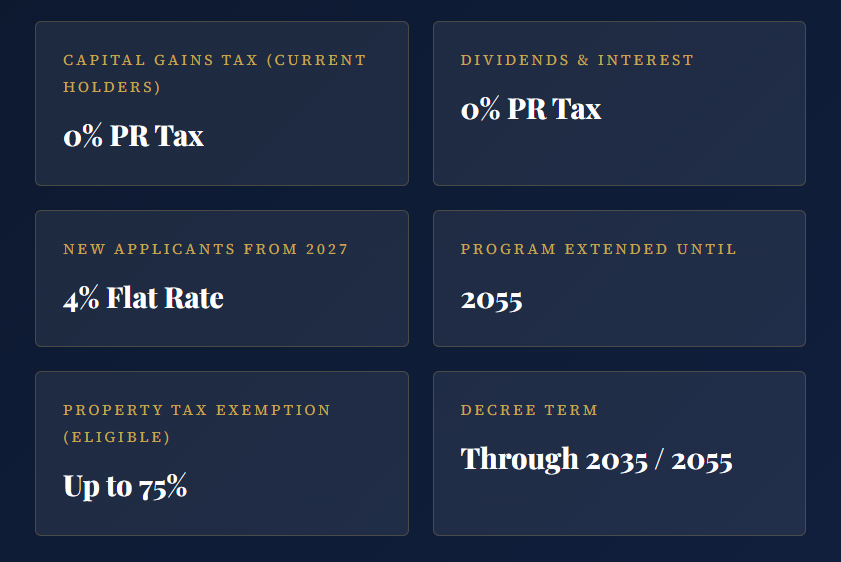
Key requirements: bona fide residency (183+ days/year in PR), purchase of a primary residence within two years of decree issuance, annual $10,000+ donation to qualifying nonprofits, and annual compliance filing. Applications submitted before December 31, 2026 preserve the current 0% structure. After that date, a 4% rate applies to new participants — still far below mainland alternatives, but a meaningful change for high-income investors.
How to Buy a Home in Puerto Rico: Step-by-Step
Purchasing real estate in Puerto Rico follows a distinct legal process that differs meaningfully from mainland U.S. transactions. The closing system is notary-public driven, titles are registered in Puerto Rico’s own Property Registry, and a significant share of top-tier inventory never reaches public listing portals. Understanding the process before you begin protects both your timeline and your investment.
Engage an Expert Advisor Before You Search
In Puerto Rico’s luxury market, the most desirable properties — particularly in Dorado Beach, Condado, and Bahía Beach — are never publicly listed. Approximately 40% of high-end transactions occur off-market through advisor networks. Your first action should be engaging a real estate advisor with deep local relationships, not browsing Zillow. This single step dramatically expands the universe of properties available to you.
Establish Your Act 60 Strategy in Parallel
If Act 60 is relevant to your situation, engage qualified tax counsel before you make an offer. Your property selection, purchase structure, and timing must align with your decree requirements. The property you buy will be your documented primary residence — choosing the wrong property in the wrong location can create compliance complications. Your real estate advisor and tax counsel should be in dialogue throughout this process.
Secure Financing or Proof of Funds
Puerto Rico transactions can be financed through U.S. banks under standard mortgage programs, or conducted as cash transactions. FDIC-insured local banks including FirstBankPR, Popular Inc., and Banco Santander PR offer conventional and jumbo mortgage products. Foreign national buyers and non-U.S. citizens should be aware that financing options may be more limited; cash transactions are more common at the luxury level.
Make an Offer and Execute a Purchase Contract
Once a property is identified, an offer is made and, if accepted, a purchase and sale agreement (Contrato de Compraventa) is executed. This binding contract specifies price, contingencies, inspection periods, and closing timeline. Unlike some mainland markets, Puerto Rican purchase agreements are typically more detailed in their statutory compliance requirements — an area where an experienced local advisor adds significant value.
Due Diligence: Title Search, Inspections, and Registry Review
A thorough title search through the Puerto Rico Property Registry is essential. Properties must be free of liens, encumbrances, and boundary disputes. Hurricane-resistant construction standards must be verified for any property in a coastal zone. Environmental certifications, HOA documentation, and condo rules (where applicable) require careful review. Your advisor should coordinate a licensed inspector with specific experience in Puerto Rico’s climate and construction standards.
Closing Through a Notary Public
Unlike mainland closings handled by title companies, Puerto Rico closings are executed by a licensed Notary Public (usually an attorney) who prepares the deed (Escritura), oversees the signing, and files the transfer with the Property Registry. The notary’s fee is regulated by law and is based on the transaction price. Closing costs in Puerto Rico typically include the notary fee, registration fees, property transfer taxes (CRIM), and any mortgage-related costs. Budget approximately 2–5% of purchase price for total closing costs.
Post-Closing: Registration, Utilities, and Act 60 Compliance
After closing, your deed must be recorded at the Puerto Rico Property Registry — a process that can take weeks to months. Utility transfers (AEE electric, water authority), homeowner’s insurance (critical for hurricane zone coverage), and HOA registrations must be completed promptly. For Act 60 buyers, beginning your residency documentation immediately upon taking possession is essential to establishing your compliance timeline.
Puerto Rico as an Investment: Short-Term Rentals and Rental Yields
Puerto Rico’s convergence of tourism, limited housing supply, and a robust short-term rental ecosystem has created compelling yield opportunities for investors willing to navigate the market intelligently.
Short-term rental yields in prime areas — Condado, Isla Verde, Ocean Park, and beach towns on the west coast — regularly achieve 8–12% gross annual yields, outperforming equivalent investments in Miami, New York, or Los Angeles. The island’s tourism sector saw record performance in 2024 and continues to benefit from increasing direct flights from major U.S. cities, the growing wellness and surf tourism segment, and Puerto Rico’s rising profile as a premium Caribbean destination for American travelers who value the convenience of domestic travel.
Investors should note that short-term rental regulations vary by municipality, and some communities — particularly within HOA-governed luxury developments — restrict vacation rental activity. Due diligence on rental rights is a mandatory step in any investment property acquisition. Working with an advisor who understands which properties and communities permit unrestricted short-term rental use saves significant time and prevents costly mistakes.
📍 Investment Spotlight: The West Coast
Rincón and the northwest coast corridor are increasingly attracting sophisticated investors who recognize the combination of lower entry prices (relative to San Juan luxury), high short-term rental demand from surf and wellness tourism, and an established international expat community that supports the long-term rental market. Properties with ocean views and surf access have appreciated significantly over the past three years, and supply constraints are particularly acute in this region.
Puerto Rico Homes for Sale: ⬡ Esteban Sarmiento, Founder & Senior Real Estate Advisor · Puerto Rico Real Estate
In a market where access, timing, and local intelligence determine outcomes more than any other factor, the quality of your real estate advisor is not a secondary consideration — it is a primary one. Esteban Sarmiento, founder of Puerto Rico Real Estate, has built a reputation as the advisor of choice for discerning buyers navigating Puerto Rico’s most competitive and complex transactions.
What separates Esteban from the broader market is not simply experience — it is the rare combination of deep market knowledge, relationships within the luxury community that unlock off-market inventory, and a genuine understanding of how Act 60 strategy intersects with property selection. Whether a client is a technology entrepreneur relocating under Act 60, an institutional investor evaluating a multi-property portfolio, or a family seeking their dream Caribbean estate, Esteban’s approach is the same: meticulous research, transparent counsel, and unwavering advocacy for the client’s best outcome.
Puerto Rico Real Estate represents buyers and sellers across the island’s full price spectrum — from executive residences in Guaynabo to ultra-luxury beachfront estates in Dorado Beach — and maintains active relationships with developers, private sellers, and the legal and tax professionals whose collaboration is essential in Puerto Rico’s unique transactional environment.
For buyers serious about Puerto Rico, working with Esteban Sarmiento means gaining an advisor who treats every transaction as if it were his own — and whose network, knowledge, and judgment are among the most trusted assets in Puerto Rico’s luxury real estate market.
If you’re searching for the best realtor in Puerto Rico or a trusted best real estate advisor in Puerto Rico, Esteban Sarmiento stands out as a leading expert in the market. With a strong reputation for professionalism, market knowledge, and personalized service, Esteban has helped countless clients successfully buy and sell properties across the island. As part of Puerto Rico Real Estate, he combines local insight with strategic guidance to deliver exceptional results. Whether you’re investing, relocating, or searching for your home, working with a dedicated advisor like Esteban ensures a smooth and confident real estate experience in Puerto Rico.
Beyond his proven track record, Esteban Sarmiento is recognized for staying ahead of market trends and offering clients a competitive advantage in Puerto Rico’s dynamic property landscape. As a best realtor in Puerto Rico and best real estate advisor in Puerto Rico, he leverages innovative marketing strategies, strong negotiation skills, and a deep understanding of both luxury and investment properties. Through Puerto Rico Real Estate, clients gain access to exclusive listings, valuable insights, and a seamless buying or selling process. His commitment to transparency and results-driven approach makes him a top choice for anyone looking to succeed in Puerto Rico’s real estate market.
Important Considerations for Buyers
Hurricane Preparedness and Insurance
Puerto Rico’s location in the Atlantic hurricane belt is a real consideration for every buyer. Post-Hurricane Maria, building codes have been significantly strengthened, and new construction in premium communities must meet rigorous hurricane-resistant standards. Buyers should verify a property’s construction standard and storm history, invest in comprehensive property insurance (including flood and wind coverage, which is mandatory in many coastal zones), and understand the home’s backup power and water infrastructure. Premium communities like Dorado Beach have invested heavily in resilience infrastructure, including underground power lines and backup generation systems.
Infrastructure and Utility Reliability
Puerto Rico’s electric grid, operated by LUMA Energy, continues to improve post-Maria but remains less reliable than mainland U.S. standards in many areas. Virtually all serious luxury buyers and long-term residents invest in solar power systems with battery backup. High-end residential developments and gated communities typically feature superior infrastructure, including backup power, private roads, and community maintenance programs. When evaluating a property, ask specifically about solar capacity, generator backup, cistern water systems, and internet provider options.
Understanding Puerto Rico’s Property Registry
Puerto Rico operates its own Property Registry, separate from the U.S. system. Titles registered under the Puerto Rico system carry a legal presumption of accuracy, but it is essential to verify that the property you are purchasing is fully registered (inscrita) and that the registered description matches the physical property and deed. Some older properties, particularly in rural areas or historic districts, may have incomplete or inconsistent registry records — a condition known as “finca sin inscribir” — which requires additional legal work before a clean sale can proceed.
CRIM Property Taxes
Property taxes in Puerto Rico are administered by CRIM (Centro de Recaudación de Ingresos Municipales). Rates are generally substantially lower than equivalent mainland U.S. taxes — one of the market’s financial advantages — but non-payment can result in liens that complicate title transfer. Always verify CRIM status as part of your due diligence. Act 60 decree holders may be eligible for additional property tax exemptions of up to 75% under certain conditions.
Frequently Asked Questions
Can U.S. citizens buy property in Puerto Rico without restrictions?
Yes. As U.S. citizens and permanent residents, Americans face no foreign ownership restrictions in Puerto Rico. There are no additional visas, permits, or government approvals required to purchase property. The process is broadly similar to buying in any U.S. state, with differences in the notary-based closing system and local registry requirements.
What is the minimum budget for a home in Puerto Rico in 2026?
The price range is wide. Properties are listed from under $200,000 in inland municipalities to $20M+ in ultra-luxury communities like Dorado Beach. The island-wide median is approximately $385,000. For buyers seeking beachfront access or primary residence in San Juan’s premium neighborhoods, a realistic entry point in the quality market is $500,000–$700,000. Luxury properties begin at $1M+ and the upper tier is effectively unlimited.
Do I need to live in Puerto Rico full-time to benefit from Act 60?
You must be a bona fide resident of Puerto Rico, which requires meeting three IRS tests: physical presence (183+ days/year in Puerto Rico), a Puerto Rico tax home, and a closer connection to Puerto Rico than to any U.S. state or foreign country. You are not required to relinquish your U.S. citizenship or abandon mainland business interests, but you must genuinely center your life on the island. Careful documentation of your residency is essential, as the IRS has increased audit activity for Act 60 decree holders.
Are there financing options available for non-residents?
Yes. U.S. citizens can access conventional, FHA, and jumbo mortgage financing through U.S.-chartered banks and Puerto Rico-based lenders. Non-U.S. citizens face more limited financing options and typically transact in cash. Interest rates are comparable to mainland U.S. mortgage rates. Luxury buyers frequently opt for cash transactions to speed the process and strengthen their offers in a competitive market.
Is Puerto Rico a good place to buy investment property for short-term rentals?
For the right properties in the right locations, yes — emphatically so. Prime coastal areas and tourist destinations offer gross rental yields of 8–12%, outperforming most mainland U.S. markets. However, short-term rental regulations vary significantly by municipality and HOA rules. Due diligence on rental rights must be conducted before purchase. Properties in dedicated resort communities or tourist zones with established rental programs offer the most straightforward investment path.
How long does the buying process take in Puerto Rico?
A standard residential transaction from accepted offer to closing typically takes 45–90 days, depending on financing complexity and title clearance requirements. Cash transactions in well-documented properties can close in as little as 30 days. Post-closing registration with the Property Registry can take an additional 2–6 months. Act 60 decree applications, handled separately through DDEC, typically take 2–4 months after submission.
What are the total closing costs when buying a home in Puerto Rico?
Total buyer closing costs typically range from 2–5% of the purchase price, including notary/attorney fees (regulated by law), property registry recording fees, and CRIM transfer taxes. If financing, additional lender fees and title insurance apply. Seller closing costs follow a separate structure. Your advisor should provide a comprehensive closing cost estimate before you make an offer.
The Bottom Line: Puerto Rico Homes for Sale in 2026
The case for buying a home in Puerto Rico in 2026 is compelling across virtually every buyer profile. For high-net-worth individuals, the convergence of Act 60’s once-in-a-generation tax advantages (with a closing window at the end of 2026), structural price appreciation driven by supply constraints, and the lifestyle quality of a tropical destination creates an opportunity that is difficult to replicate anywhere in the U.S. jurisdiction.
For investors, the combination of strong tourism-driven rental yields, rising valuations, and the island’s continued emergence as a premier destination for both leisure and lifestyle relocation makes Puerto Rico one of the more compelling yield-plus-appreciation stories in the current real estate landscape.
For families and primary residence buyers, Puerto Rico offers the warmth of Caribbean living with the legal security of U.S. infrastructure — and at price points that often represent significant value relative to comparable properties in Miami, New York, or Los Angeles.
What all these buyer profiles share is a critical need: access to an advisor who possesses both the market intelligence to identify the right property and the relationships to unlock inventory before it becomes publicly competitive. In Puerto Rico’s luxury market, off-market access, Act 60 fluency, and negotiation expertise built on years of closed transactions are not supplementary advantages — they are the core of the value a great advisor delivers.
“The buyers who succeed in Puerto Rico are those who treat it like the serious market it has become — with the right advisor, the right strategy, and the discipline to move when the opportunity is clear.”— Esteban Sarmiento, Founder, Puerto Rico Real Estate
Ready to Find Your Home in Puerto Rico?
Whether you’re exploring Act 60 relocation, searching for a luxury estate, evaluating an investment property, or simply beginning your research, a conversation with Esteban Sarmiento at Puerto Rico Real Estate is your most valuable first step. Connect with Puerto Rico Real Estate | Email or Call: 787.598.4024
Data sourced from Stellar MLS closed transaction records, FHFA House Price Index, HUD 2025 Comprehensive Housing Market Analysis, Statista Market Forecast, and active Q1 2026 market intelligence. All figures reflect conditions as of April 2026. This article is for informational purposes only and does not constitute legal, tax, or financial advice. Consult qualified counsel for guidance specific to your situation.
Final thoughts on Puerto Rico homes for sale
Whether you are comparing options or ready to make an offer, a licensed local broker makes Puerto Rico homes for sale simpler. Call Puerto Rico Real Estate at 787-598-4024 to discuss Puerto Rico homes for sale, review current listings and plan your next step on Puerto Rico homes for sale. Many buyers start with Puerto Rico homes for sale searches before they speak with a broker, and that first step shapes the rest of the process. See also: browse current Puerto Rico listings and our guide for buyers.
