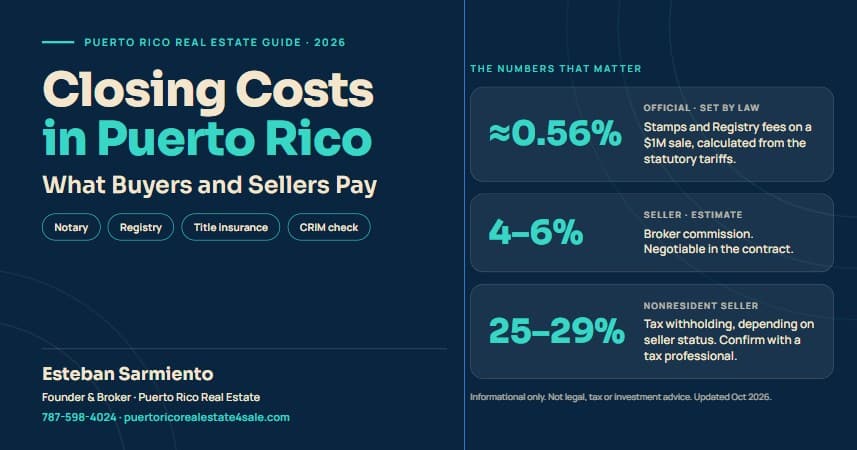
Closing costs in Puerto Rico combine fixed government fees with negotiated professional charges for Puerto Rico Real Estate transactions. The government part follows statutory formulas: stamps on the deed and a Registry of Property tariff. On a $1 million sale, those items total about $5,600 with one certified copy, or roughly 0.56% of the price. Notary fees, title insurance and lender charges come on top, and the contract sets who pays each one.
Experience adds a second lesson. Esteban Sarmiento, founder and broker of Puerto Rico Real Estate, a luxury real estate boutique firm, has seen luxury closings where the CRIM never assessed the property. After the sale, the CRIM claimed taxes retroactively. The contract made the seller responsible for the period before closing, yet collecting from the seller often proved very complicated and sometimes close to impossible. Undeclared improvements have caused the same problem.
This guide breaks down each cost, who normally pays it and the checks that protect buyers and sellers before closing.
Key takeaways
- A notary public executes the deed in person, and the deed drives most costs.
- Official stamps and Registry fees total about 0.56% of the price in the examples below.
- Notary fees, title insurance and lender charges have no statutory price. Buyers ask for quotes.
- Withholding on nonresident sellers: 15% for U.S.-citizen individuals, 25% for other individuals and 29% for foreign corporations, per published sources.
- An unassessed property or undeclared improvements can trigger a CRIM claim after closing.
What are closing costs in Puerto Rico?
Closing costs are the fees and taxes that move a property from seller to buyer. In Puerto Rico, they center on a public deed signed before a notary, plus stamps, Registry of Property fees, title protection and any lender charges. The purchase contract sets who pays each item.
Lawful transfers of title to real estate in Puerto Rico happen through a public deed that the parties execute in person before a notary public. Recording the deed in the Registry of Property is customary and recommended, although the law does not technically require it. Now you know who pays closing costs in Puerto Rico.
What do the official government fees cost?
Two official fee schedules set the government portion. The Notarial Fee Act sets Internal Revenue and Legal Aid stamps on the deed and its copies. The Registry of Property Fee Act sets the recording tariff. On a $1 million sale with one certified copy, these items total about $5,617, or roughly 0.56%.
| Item | Official rule | Law |
|---|---|---|
| Registry presentation entry | $15 per document | Law 91 of 1970 |
| Registry inscription | For values above $25,000, $50 on the first $25,000 plus $4 per each additional $1,000 or fraction | Law 91 of 1970 |
| Internal Revenue stamps, deed original | For amounts above $5,000, $2 on the first $1,000 plus $1 per additional $1,000 or fraction | Law 101 of 1943 |
| Internal Revenue stamps, each copy | $1 on the first $1,000 plus $0.50 per additional $1,000 or fraction | Law 101 of 1943 |
| Legal Aid Society stamps, sale deeds | $5 on the original and $2.50 per copy for amounts from $25,000 to $50,000, plus the same again for each additional $50,000 or fraction | Law 101 of 1943, as amended by Law 244 of 2004 |
Worked examples on who pays closing costs in Puerto Rico (calculated from the statutes above):
| Item | $1,000,000 sale | $5,000,000 sale |
|---|---|---|
| Registry presentation | $15 | $15 |
| Registry inscription | $3,950 | $19,950 |
| Internal Revenue stamps, original | $1,001 | $5,001 |
| Internal Revenue stamps, one copy | $500.50 | $2,500.50 |
| Legal Aid stamps, original | $100 | $500 |
| Legal Aid stamps, one copy | $50 | $250 |
| Total | $5,616.50 | $28,216.50 |
| Share of price | about 0.56% | about 0.56% |
These figures assume one certified copy and a cash purchase. Each extra copy adds stamps. A purchase mortgage adds its own stamps and Registry fees, calculated on the loan amount under the same schedules. The notarial tax stamp, notary fee, title insurance and lender charges come on top. The exact total comes from the notary, so buyers should request an itemized estimate.
Who pays closing costs in Puerto Rico, the buyer or the seller?
Custom splits the costs by role. Buyers typically pay notary, legal, registry and lender-related fees. Sellers typically pay the broker commission and settle liens and taxes tied to the property. Parties can negotiate any item, so the written purchase agreement controls. See the break down on who pays closing costs in Puerto Rico.
| Cost | Usually paid by | Notes |
|---|---|---|
| Stamps and Registry fees | Set by the contract | Official formulas above. Confirm the allocation in writing. |
| Notary fees | Buyer, typically | Global Property Guide estimates 0.5% to 1% for the buyer. Negotiable. |
| Title study and title insurance | Buyer, typically | Ask the title company for a quote. |
| Broker commission | Seller | Global Property Guide estimates 4% to 6%. Negotiable. |
| Existing mortgage cancellation | Seller | The Registry tariff charges a fee based on the mortgage principal to cancel a current mortgage. |
| CRIM balances and assessment issues | Seller, by contract | See the CRIM section below. |
| Appraisal and lender charges | Buyer, if financing | The bank verifies credit, orders the appraisal and studies the title. |
| Nonresident seller withholding | Buyer withholds, seller bears the tax | 15% for U.S.-citizen individuals, 25% for other individuals, 29% for foreign corporations. |
How much are closing costs in Puerto Rico overall?
The official stamps and Registry fees come to about 0.56% of the price in the examples above. Notary fees, title insurance and lender charges add to that. Third-party estimates for the full buyer total range from about 1% to 2% up to about 5%, depending on what each source counts. An itemized estimate gives the reliable number.
These third-party figures are estimates, not official rates. Global Property Guide estimates buyer costs at 1% to 2%. HAR Global Properties tells buyers to expect roughly 5% for closing costs and taxes. The gap comes from what each source includes who pays closing costs in Puerto Rico.
What does the notary do at a Puerto Rico closing?
A notary public authorizes the deed that transfers title, and the parties sign it in person. The notary also affixes and cancels the stamps the law requires. Under current law, the notary’s fee comes from an agreement between the parties and the notary.
A pending Senate bill would replace negotiated notary fees with a mandatory fee structure that sets minimum rates. Buyers should verify the bill’s status before they budget.
What are Registry of Property fees?
The Registry of Property records the deed so the buyer’s ownership appears in the public record. Recording is customary and recommended. Fees follow the statutory tariff shown above, which scales with the value of the property. The Registry does not accept a document without proof of payment of the full fees.
Do buyers need title insurance in Puerto Rico?
Title insurance is common in most Puerto Rico residential deals. A title study reviews liens and ownership history, and the policy protects the buyer against covered defects. Buyers should request both quotes before they sign the purchase agreement, so the cost enters the budget early.
Title insurance is common in commercial and most residential transactions in Puerto Rico. The premium varies by property and insurer, so buyers ask the title company for a written quote. Now you know buyer closing costs Puerto Rico.
What do sellers pay, and what can delay or reopen the sale?
Sellers typically pay the broker commission and clear mortgages and tax balances before the deed. Two issues can delay a closing or create claims afterward: the CRIM’s assessment status and, for nonresident sellers, Hacienda withholding. Early certifications keep the closing date firm and reduce surprises.
Why do unassessed luxury properties create risk after closing?
Esteban Sarmiento has handled luxury transactions where the CRIM had never assessed the property. After the sale, the CRIM claimed taxes retroactively. The purchase contract clearly made the seller responsible for the period before closing. Even so, collecting from the seller often proved very complicated and sometimes close to impossible. Improvements that the owner never declared have produced the same result.
A 2025 Senate bill describes a common mortgage-industry practice of holding back seller funds when the CRIM has not assessed a property.
Esteban Sarmiento advises buyers and sellers to take these steps before signing:
- Ask the CRIM for the property’s statement of account and value certification.
- Confirm that the CRIM has assessed the property under the correct cadastral number.
- Compare the improvements on site, such as pools, additions and guest houses, with the improvements declared.
- Negotiate a written holdback or escrow for post-closing CRIM claims.
- Review the contract language with a licensed attorney.
What happens when a nonresident sells?
Section 1062.08(g) of the Internal Revenue Code requires a buyer to withhold tax on payments toward the price when the seller is a nonresident. A buyer who fails to withhold can owe the amount directly to Hacienda. Published sources put the withholding at 15% for a U.S.-citizen individual, 25% for any other individual and 29% for a foreign corporation (Hacienda Bulletin BI RI 22-01 describes the buyer’s obligation). A tax professional must confirm the rate and the paperwork for each sale.
What extra costs do financed buyers pay?
Financed buyers pay for the lender’s work on top of the deed costs. The bank checks credit, orders the appraisal and studies the title, then confirms the money due at closing. Buyers ask the lender for a written estimate of cash to close before they make an offer.
How do closing costs work for luxury buyers and Act 60 relocators?
Closing costs scale with price, so a luxury purchase carries larger dollar amounts even when the process stays the same. The stamps and Registry fees alone reach about $28,000 on a $5 million sale. Foreign buyers face no ownership restrictions, and Act 60 questions belong with a tax professional.
Puerto Rico places no restrictions on foreign ownership of real estate. Puerto Rico Real Estate, a luxury real estate boutique firm, relocates individuals and families under Act 60 and serves luxury buyers across Puerto Rico. Its team checks CRIM status and declared improvements before the contract, because luxury properties carry the largest exposure.
What does closing day look like?
Closing follows a clear sequence. The buyer’s deposit applies toward closing, the parties coordinate the date and final amounts, and the buyer signs the deed before a notary and receives the keys.
Closing cost checklist
- Ask the notary, title company and lender for itemized estimates.
- Confirm in the contract who pays each item.
- Order the title study early.
- Check the CRIM assessment, cadastral number and tax balance.
- Verify that the improvements on site match the declared improvements.
- Negotiate a holdback for post-closing CRIM claims.
- Start the Hacienda process early if the seller is a nonresident.
- Review the final figures before the signing date.
Frequently asked questions
Can foreigners buy property in Puerto Rico?
Yes. Puerto Rico places no restrictions on foreign ownership of real estate.
Does Puerto Rico charge a property transfer tax?
Global Property Guide lists no property transfer tax. The deed still carries Internal Revenue and Legal Aid stamps, and the Registry charges its tariff. A tax professional should confirm the current rules.
Do I need a lawyer to buy property in Puerto Rico?
A lawyer is not mandatory but highly recommended. A notary must execute the deed in any case.
Who pays the real estate commission?
The seller typically pays it, and it is negotiable. Estimates run from 4% to 6%.
What happens if the CRIM bills the property after closing?
The contract can make the seller responsible for the period before closing. Collecting later can be slow and uncertain. Buyers reduce the risk by checking the assessment and declared improvements before signing and by negotiating a holdback.
How much is withheld when a nonresident sells?
Published sources put the withholding at 15% for a U.S.-citizen individual, 25% for any other individual and 29% for a foreign corporation. The buyer withholds, and a tax professional confirms the rate for each sale.
How much cash do I need at closing?
It depends on the price, the financing and the negotiated terms. Request an itemized estimate from the notary, title company and lender before you make an offer.
Plan your closing with an expert
If you are buying, selling or relocating to Puerto Rico under Act 60, contact Esteban Sarmiento’s team for a private consultation and an itemized closing plan.
- Phone / WhatsApp: 787-598-4024
- Email: info@puertoricorealestate4sale.com
- Website: puertoricorealestate4sale.com
- Office: Caribbean Tower #828, 670 Av. Juan Ponce de León, San Juan, PR 00907
- LinkedIn | Instagram | TikTok | YouTube | Facebook
About the author
Esteban Sarmiento is the founder and broker of Puerto Rico Real Estate, a luxury real estate boutique firm in Puerto Rico. He has worked in real estate since 2008. He also brings extensive experience in Latin America on large-scale commercial projects, covering planning, acquisition and disposition of assets. The firm relocates individuals and families under Act 60, serves luxury buyers, and offers luxury residential and commercial properties, investment opportunities and a broad inventory of off-market properties, including hotels and strategic investments across the island.
Sources
- Ley 91-1970, Arancel del Registro de la Propiedad (rev. April 2024)
- Ley 101-1943, Ley de Arancel Notarial (rev. April 2024)
- Ley 244-2004, sellos de Asistencia Legal
- Hacienda: Boletín BI RI 22-01, retención a vendedores no residentes
- Chambers: Real Estate 2026, Puerto Rico
- Senado de PR, PS 286 (2025), propiedad no tasada por el CRIM
- Senado de PR, PS 1033, honorarios notariales
- Global Property Guide: Buying Property in Puerto Rico
- FindItPR: Buy your property in Puerto Rico
- HAR Global Properties: Puerto Rico FAQs
This content is for informational purposes only. It is not an appraisal or legal, tax or investment advice. Consult a licensed attorney, tax professional or financial advisor about your specific situation.
