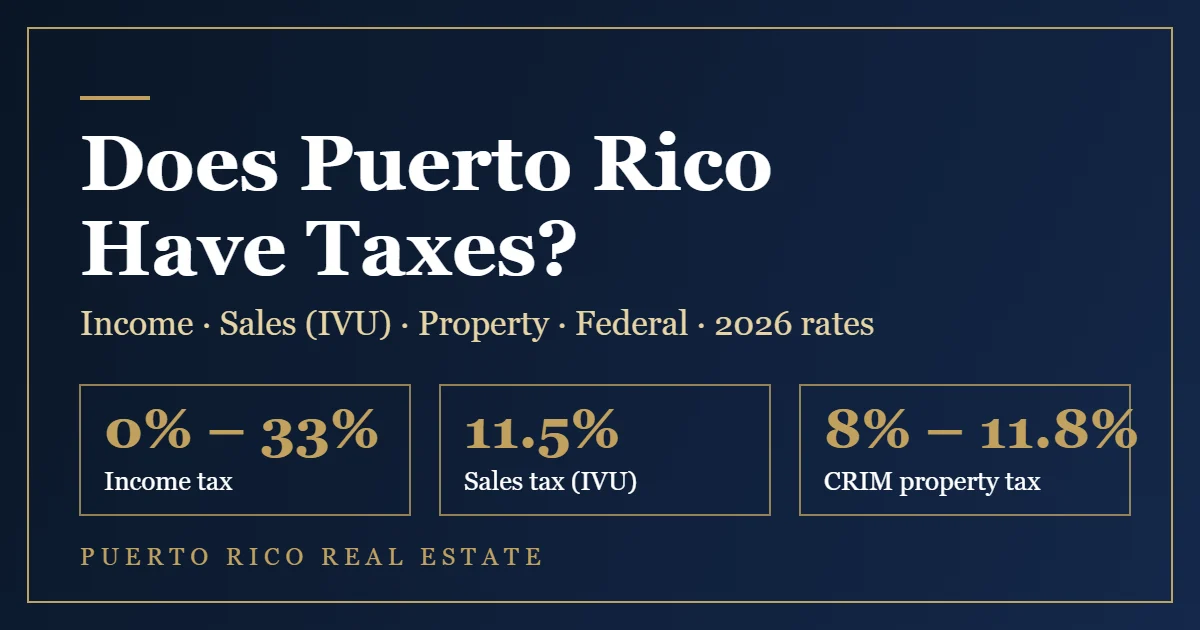
Yes, Puerto Rico has taxes. Residents pay income tax to Puerto Rico’s Treasury Department (Hacienda) at rates from 0% to 33%, an 11.5% sales and use tax (IVU), municipal property tax (CRIM) and U.S. payroll taxes. However, most residents who earn only Puerto Rico income do not file a federal income tax return.
Many people hear that the island has “no taxes” and then find a more detailed picture. First, this guide shows each tax, the 2026 rates and what they mean when you buy a home on the island. I am Esteban Sarmiento, broker at Puerto Rico Real Estate (license C-13046), and these are the tax questions buyers ask me most. Please note that this guide is informational. Also, it is not legal or tax advice.
Does Puerto Rico have taxes? Quick answer by tax type
| Tax | Who collects it | 2026 rate | What to know |
|---|---|---|---|
| Income tax | Hacienda (Puerto Rico Treasury) | 0% to 33% | Residents pay on worldwide income |
| Sales and use tax (IVU) | Hacienda and the municipality | 11.5% (10.5% + 1%) | Reduced 4% on certain business and professional services |
| Property tax | CRIM (municipal) | About 8% to 11.8% of assessed value | $15,000 exemption on a primary residence |
| Payroll taxes | IRS (federal) | Social Security and Medicare | Same system as the U.S. mainland |
| Net wealth tax | None | Not applicable | The island does not tax net worth |
Income tax: the 2026 brackets
Yes. When people ask “does Puerto Rico have taxes on income,” the answer is that the island runs its own income tax system, separate from the IRS. For example, Hacienda taxes individuals on a graduated scale. Here are the 2026 brackets for individuals:
| Taxable income | Tax rate |
|---|---|
| Up to $9,000 | 0% |
| $9,001 to $25,000 | 7% |
| $25,001 to $41,500 | 14% |
| $41,501 to $61,500 | 25% |
| Over $61,500 | 33% |
Also, capital gains are taxed at 15% for individuals. However, higher earners can owe additional taxes, and the island also applies an alternative basic tax, so your final bill can differ from the table. Lawmakers introduced a bill in January 2026 to lower these rates, so check Hacienda or a tax professional before you file.
Federal income tax for residents
Usually not on income earned in Puerto Rico, even though Puerto Rico has taxes of its own. For example, the IRS says a bona fide resident of Puerto Rico whose only income comes from Puerto Rico sources generally does not need to file a U.S. federal income tax return. However, three details matter:
- Residents still pay Social Security and Medicare taxes.
- Income from outside Puerto Rico, or from the U.S. government, can still be reportable to the IRS.
- Residents who do not file a federal return may still need to report self-employment income and pay self-employment tax.
Sales tax (IVU) on everyday purchases
Sales tax is part of the answer to whether Puerto Rico has taxes. The sales and use tax, called IVU (Impuesto sobre Ventas y Uso), is 11.5% on most purchases. First, the Commonwealth collects 10.5% and the municipality collects 1%. Also, the rate is the same in San Juan, Dorado and every other municipality. However, many business-to-business services and designated professional services pay a reduced 4% rate.
How much is property tax in Puerto Rico?
CRIM, the municipal revenue collection center, collects property tax on the assessed value, which is often far below today’s market price. Also, combined rates run from about 8% to 11.8% depending on the municipality, and a primary residence gets an exemption on the first $15,000 of assessed value. Read our full guide to Puerto Rico property taxes (CRIM) before you make an offer.
Does Act 60 mean you pay no taxes?
No. Act 60 can lower the tax rate on certain qualifying income for approved residents, but it does not remove every tax. You still need to meet the bona fide residency tests. For example, applications filed by December 31, 2026 keep the 0% rate on qualifying income, and applications from January 1, 2027 fall under Act 38-2026 at 4%. Also, our guide to moving to Puerto Rico and Act 60 explains the residency tests.
What this means when you buy a home
- Ask your attorney for the CRIM tax debt certificate before you close, so you do not inherit unpaid property tax.
- Also, budget for closing costs in Puerto Rico as well as yearly CRIM bills.
- Then compare the full monthly picture in our cost of living guide and our house prices by municipality.
- Talk to a tax professional with Puerto Rico experience before you move or sign a decree.
- Looking at the coast? Browse beachfront homes for sale in Puerto Rico.
Now you know whether Puerto Rico has taxes and how they work. Ready to see what is available? Browse homes for sale in Puerto Rico or contact me for a private consultation.
Frequently asked questions
Here are quick answers for anyone who asks “does Puerto Rico have taxes” before buying or moving.
Does Puerto Rico have taxes?
Yes. Residents pay income tax to Hacienda (the island’s Treasury Department), an 11.5% sales and use tax (IVU), municipal property tax through CRIM and U.S. payroll taxes such as Social Security and Medicare. Also, the island has no net wealth tax.
Is there income tax in Puerto Rico?
Yes. The island has its own income tax system with graduated rates from 0% to 33% for 2026. Also, residents pay tax on their worldwide income. However, some incentives, such as Act 60, can change the rate for qualifying residents.
Do residents pay federal income tax?
Usually not on income earned in Puerto Rico. For example, the IRS says a bona fide resident whose only income comes from Puerto Rico sources generally does not need to file a U.S. federal income tax return. Residents still pay Social Security and Medicare taxes, and income from outside Puerto Rico or from the U.S. government can still be reportable to the IRS.
What is the IVU sales tax rate?
The sales and use tax, called IVU, is 11.5% on most purchases: 10.5% for the Commonwealth and 1% for the municipality. Also, it is the same in every municipality. However, some business-to-business and designated professional services pay a reduced 4% rate.
How much is property tax in Puerto Rico?
CRIM collects property tax on the assessed value, not the market price. Also, combined rates run from about 8% to 11.8% depending on the municipality, and a primary residence gets an exemption on the first $15,000 of assessed value. Read our full CRIM guide for details.
Does Act 60 mean I pay no taxes?
No. Act 60 can lower the tax rate on certain qualifying income for approved residents, but it does not remove every tax. For example, applications filed by December 31, 2026 keep the 0% rate on qualifying income, and applications from January 1, 2027 fall under Act 38-2026 at 4%. Talk to a tax professional before you decide.
Sources
- Deloitte, Puerto Rico Tax Highlights 2026
- PwC Tax Summaries, Puerto Rico individual taxes on personal income
- PwC Tax Summaries, Puerto Rico individual other taxes (IVU, property, wealth)
- IRS Tax Topic 901, income from sources within Puerto Rico
Updated November 2026. So, does Puerto Rico have taxes that apply to you? That depends on your residency and income. Rates and rules can change, so confirm current figures with Hacienda and a licensed tax professional.
